
Bumpy Forest Guide: Marupoyo World 1 Routes
Clear Marupoyo's Bumpy Forest with cleaner lines: mushroom launches, river crossings, hidden corn and the habits that carry into later worlds.
Bumpy Forest is the first world in Marupoyo, and it is the one that decides whether the rest of the game clicks. The levels are green, open and generous, with wide grass ledges, slow rivers and a lot of mushrooms. Nothing here is actively cruel. The challenge is that the forest lets you roll at full speed for long enough to build habits that snow and lava will punish later. The all-worlds guide→ shows where Bumpy Forest sits in the full progression.
This guide focuses on the route logic rather than a level-by-level map. The game has 120 levels and does not publish individual stage names, so inventing a numbered walkthrough would be worse than useless. What we can do is explain how the forest's objects behave, where corn tends to hide, and how to practise the two skills the world is quietly teaching.
What the forest is teaching
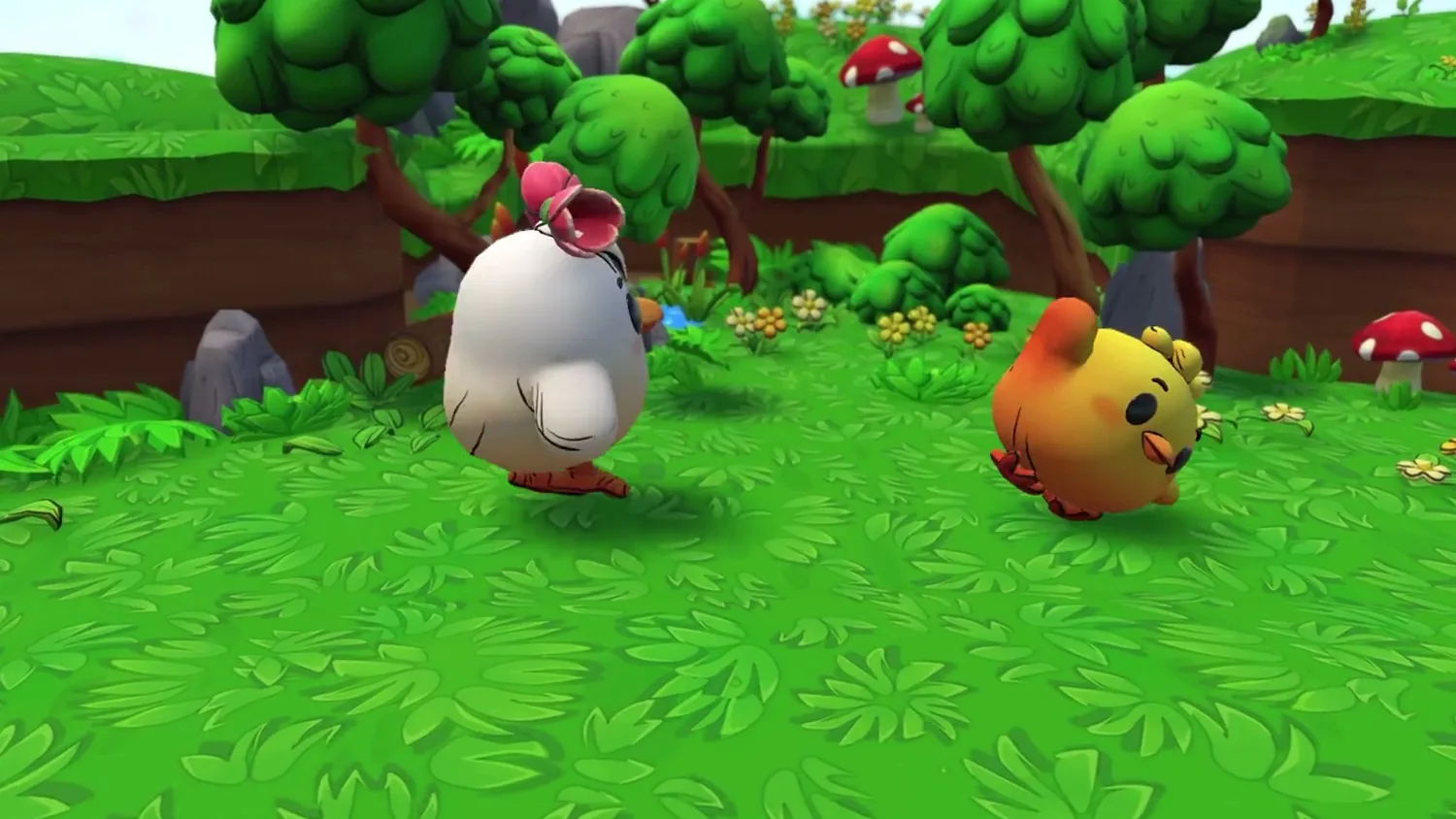
The first lesson is that the chick keeps rolling. Grass has enough grip to slow you gradually, but it does not stop you. If you centre the stick on a slope, the chick continues downhill until the slope flattens. New players read this as input lag. It is not; it is momentum, and the forest is the safest place to feel it.
The second lesson is that height comes from geometry, not from a button. Logs, roots and mushrooms create launches. A mushroom is not a trampoline you activate; it is a surface that redirects your speed upward. Hit it at a shallow angle and you get a small hop. Hit it at full speed and you can clear a river. The mushroom does not care whether you wanted to jump.
Those two lessons are the whole world. The levels get longer and the collectibles get sneakier, but the physics do not change.
Reading the forest's three layers
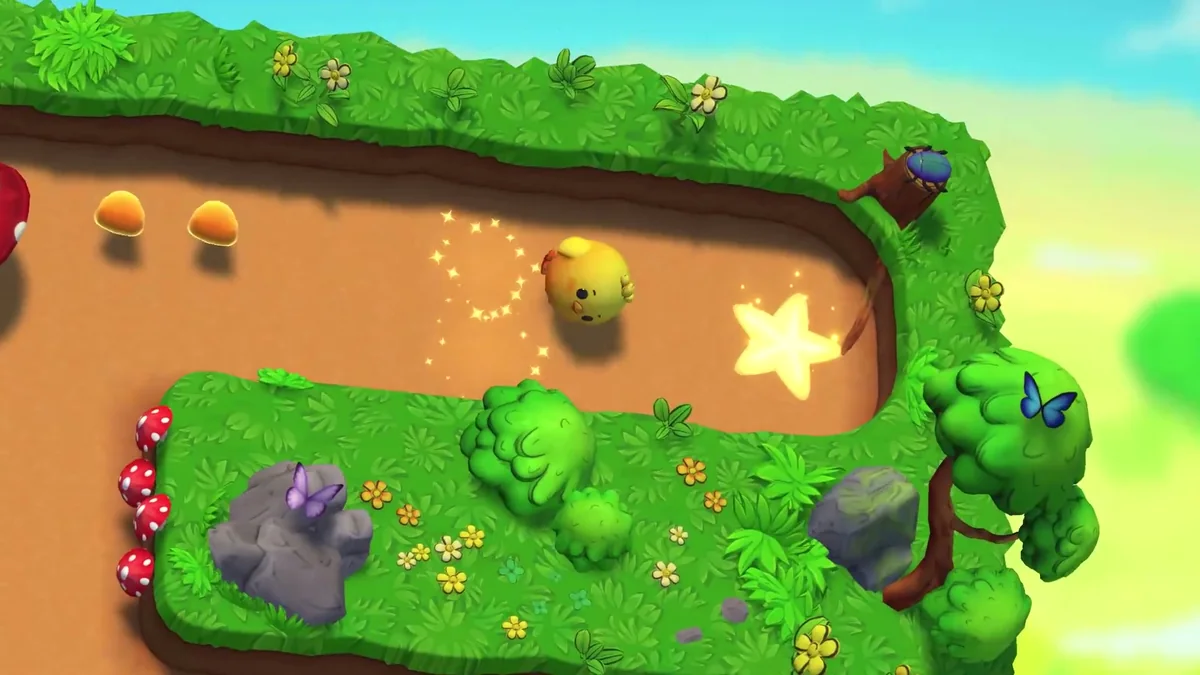
Most forest levels are built in three layers: a low path along the water, a mid-level grass shelf, and a high route over logs or mushrooms. The camera shows all three at once, which is why the world feels open. The mistake is to treat the lowest path as the main route.
The low path is usually the safest place to learn a level, but it is also where the camera clips the most. Corn placed near the water can sit just outside the natural view, especially when the chick is on the high route. If you finish a stage at 80% or 90%, roll the low path backwards before you assume the missing kernel is unreachable.
The high route is faster and usually holds the more valuable collectible line. It is also where the mushrooms are. Use the high route when you are comfortable with the level; use the low route when you are learning it.
Mushrooms: aim, do not chase
A mushroom launch is determined by your entry angle and speed. If you steer toward the mushroom at the last second, you will often clip its side and lose the launch. The reliable technique is to line up early, let the chick roll straight, and brake only if you are arriving too fast.
The best practice target is any mushroom beside a river. Approach it from upstream, let the current carry you into the mushroom at a diagonal, and see where you land. You will overshoot the first few times. That is fine; the forest's water is forgiving, and the restart is quick.
Once you can land a mushroom launch consistently, try the same launch with a brake tap just before contact. The reduced speed gives you a shorter arc, which is often what you need to land on a small shelf instead of the far bank.
Corn in the forest
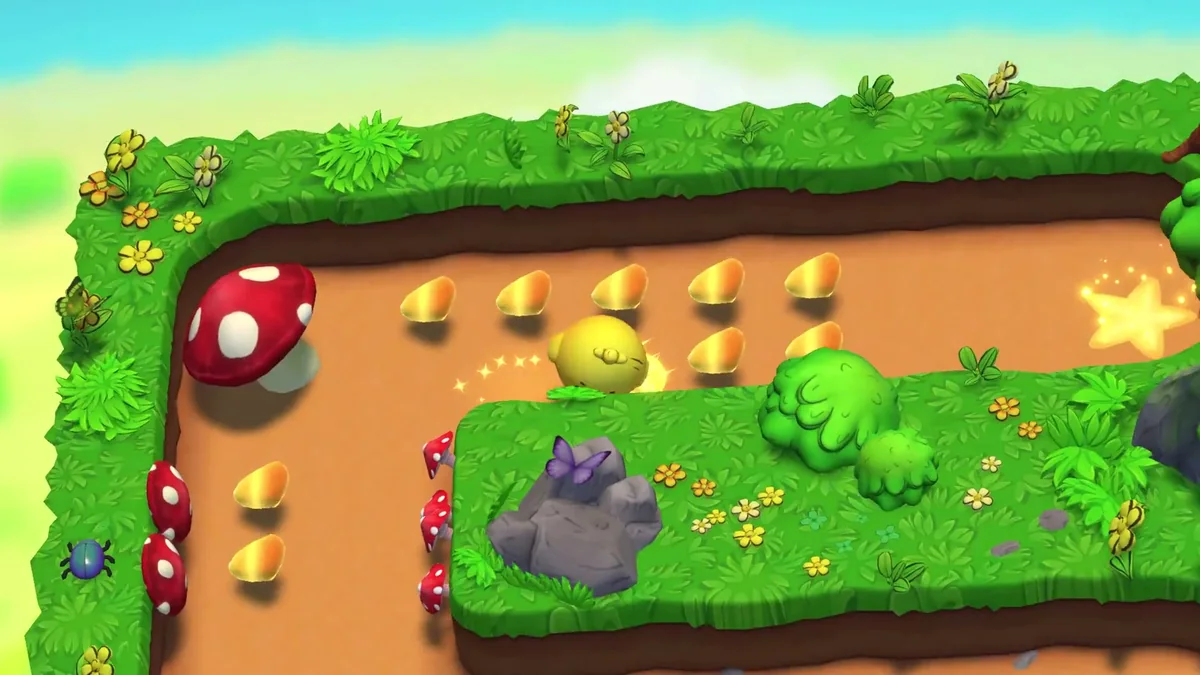
Forest corn is placed in three patterns. The first is a line along the main path, which you will collect without thinking. The second is a cluster behind a log or under a ledge, visible only from the return direction. The third is a reward for a mushroom launch, usually hanging in the air above a river or on a shelf that the low path cannot reach.
The second pattern is the one that costs people the most time. A log that looks like scenery often has a gap behind it, and the gap contains two or three kernels. Before you leave a clearing, roll a slow loop around the biggest log. It takes ten seconds and saves a replay.
The corn guide→ explains how the 100% reward and the medal system interact, including why a level can show full corn and still fail a challenge objective.
Rivers and water
The forest's rivers are hazards, but they are not all instant failures. Some are shallow enough to cross at speed; others have a current that carries you toward a waterfall. The visual difference is the foam line: a strong current has a clear white edge, while a calm channel is flat and dark.
If you are unsure, brake at the bank and look for the next platform. If there is no platform within a short roll, the river is a boundary, not a crossing. Do not test it at full speed; the restart cost is higher than the look.
The river also hides collectibles. Corn can sit on a stone in the middle of a channel, reachable only by a mushroom launch from the bank. If you see a lone golden glint in the water, mark the position and come back with a full-speed approach.
Enemies and bumps
The forest is light on enemies. The footage shows small creatures that follow fixed paths and bump the chick rather than chase her. A bump costs momentum and can knock you into a river, but it does not start a combat encounter. There is no attack button, so the answer is always positioning.
Wait for the creature to move away from the gap, then roll through. If the path is narrow, brake on the safe side and let the creature pass. Trying to beat a patrol by accelerating through it is the most common way to lose a clean run.
A clean-up route for the world
Clear the forest once without chasing completion. Then replay each level in this order: corn first, mushrooms second, music tracks last. Corn routes are the easiest to learn because the kernels are visible; mushroom routes are the most physical; music tracks are usually hidden behind the camera or in a side branch.
If you are aiming for the no-death trophy, do the forest cleanup in Gamer Mode only after you have cleared the world twice. The forest is the best place to bank a safe early segment, but a careless river crossing can still end the run.
Clear the level for corn before chasing its target time. The route knowledge carries over, and the extra corn often sits on the safer line.
FAQ
How many levels are in Bumpy Forest?
The game confirms 120 levels across six worlds but does not publish a per-world count. Treat twenty as a rough average, not a guarantee, and use the level select screen as the authority.
Does Bumpy Forest have a boss?
No boss has been confirmed for the forest. The world's trophy is awarded for clearing its levels, and the game's marketing does not describe a forest boss.
Why does the chick keep rolling after I stop?
That is the core physics. The chick has momentum and the ground has slope. Centring the stick stops your input, not the roll.
How do I reach corn above the river?
Look for a mushroom on the bank. A full-speed launch at a shallow angle will carry you to the shelf or stone where the corn sits. If there is no mushroom, the corn is probably reachable from the high route instead.
Official source: Marupoyo on Steam ↗
Related
- Marupoyo All Worlds Guide: Order and Hazards→
- Marupoyo Beginner Guide: Roll Before You Run→
- Marupoyo Corn Guide: Every Kernel and Reward→