
Snowy Trail Guide: Marupoyo World 2 Ice Routes
Snowy Trail adds ice to Marupoyo. Learn earlier braking, shallow arcs and safe water crossings before the later worlds raise the stakes.
Snowy Trail is where Marupoyo stops being a gentle roll and starts asking questions. The forest taught you that the chick keeps moving. The snow adds a surface where she keeps moving longer, turns wider and arrives at the edge of a cliff with more speed than you planned. The world is not unfair, but it is honest: every habit you brought from the forest is about to be tested. The all-worlds guide→ explains how Snowy Trail builds on the forest's surfaces.
This guide covers the ice model, the water crossings that catch people out, and the collectible patterns that make the snow world worth a second pass. It does not invent level names or claim a boss that the game has not shown.
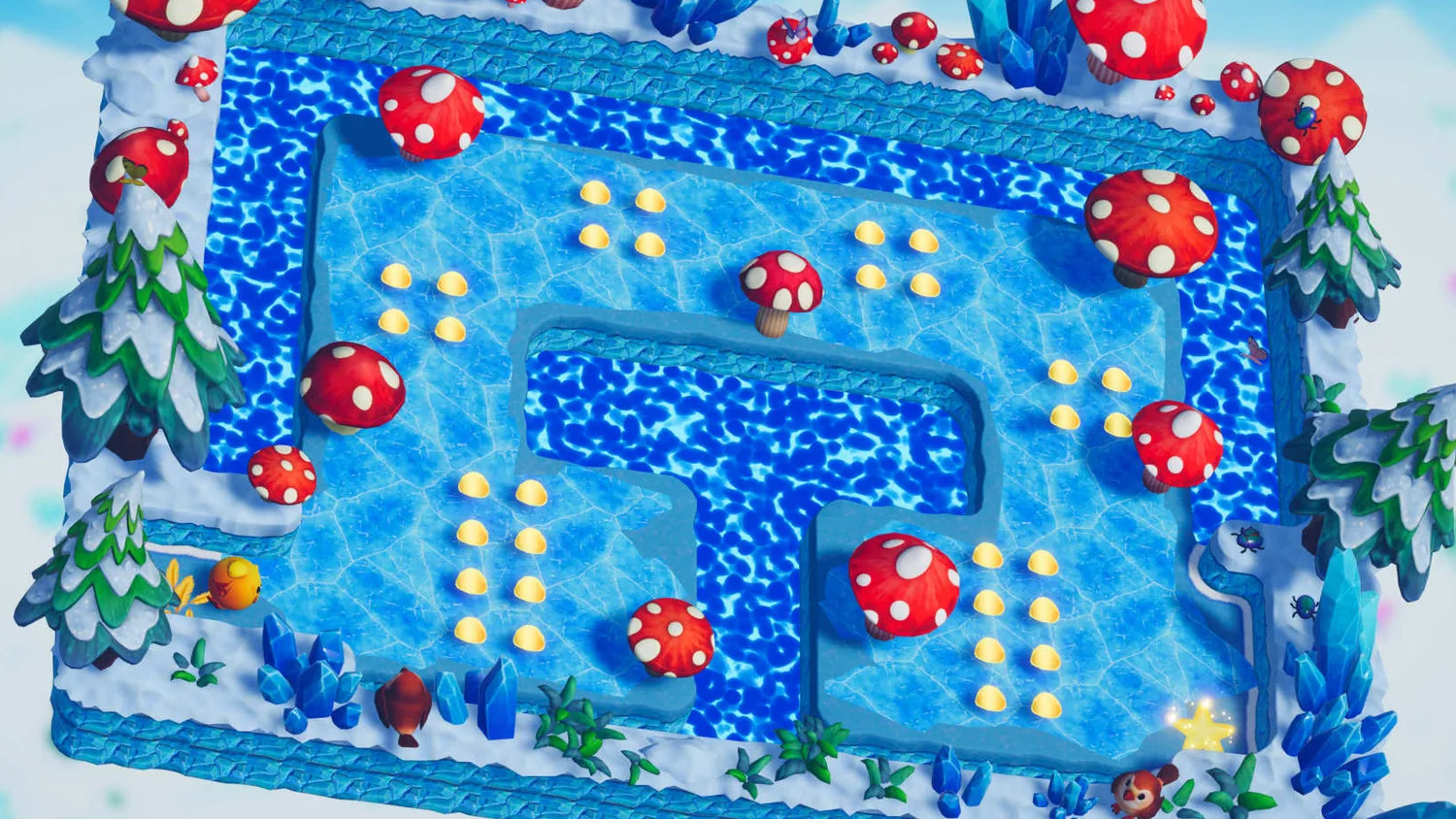
Ice is a different brake
On grass, the brake removes speed quickly enough that you can correct a line late. On ice, it removes speed slowly. The practical result is that you need to brake roughly twice as early, and you need to brake in shorter taps rather than one long hold. A long hold on ice can lock the chick into a straight slide just when you need to turn.
The better technique is to approach every ice corner slower than feels necessary. Let the chick carry a shallow arc around the corner, then release the brake and let the slope accelerate her out. You lose a little top speed, but you keep control of the exit line, which is what the level actually grades.
If you are using motion controls, reduce the tilt range on ice. A large lean that feels expressive on grass will send you into the outer wall on ice. Small, early inputs are the whole skill.
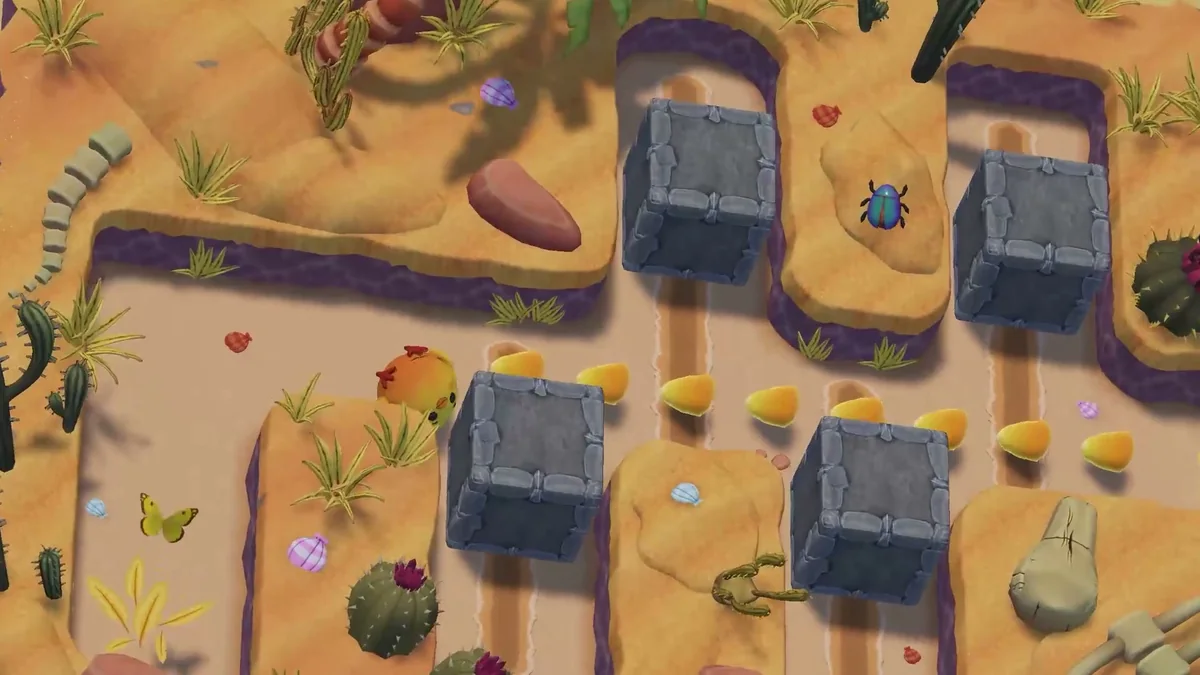
Read the edge before the corner
Snow levels use white-on-white geometry, and the edge of a platform can disappear against the background. The game helps with shadows and colour contrast, but the effect is strongest when you are looking ahead rather than at the chick. Pick the next platform's edge as your target, not the chick's current position.
The camera's angle also compresses distance on downhill sections. A gap that looks short from the top can be long enough to need a full-speed launch. If you cannot see the landing, brake at the lip and look over it. The snow world is generous with safe ledges to stop on; use them.
A useful rule: if the path turns and drops at the same time, treat it as two separate problems. Brake before the turn, complete the turn, then release and let the drop happen. Trying to solve both at once is how the chick ends up in the water.
Water crossings
Snowy Trail's water is the second hazard, and it is colder-looking than the forest's rivers. The channels are often wide, with stepping stones or ice floes that move. The current is slower than in Streams of Joy, but the cold colour palette makes the safe route harder to read.
Cross at a diagonal, not straight across. A diagonal entry gives you more time on each stone and a better exit angle. If a stone is moving, wait for it to reach the near side, then commit; chasing a moving stone from the middle of the channel is a restart.
The game's surfaces include movable and pass-through elements as well as solid ones. In practice, that means some platforms can be rolled through rather than landed on. If a stone looks thin and the chick passes behind it, do not assume the game glitched; check whether it is a foreground object.
Corn and stars in the snow
The snow world uses the same corn language as the forest: lines along the main path, clusters behind objects, and a few kernels on optional ledges. The difference is that the optional ledges are often ice shelves that break the line if you stop on them.
The footage also shows star-shaped pickups in the snow. These are separate from corn and appear in several worlds. Treat them as route markers: a star usually sits on the intended line, and a cluster of stars marks a launch or a sequence. They are not a substitute for corn when you are chasing 100%.
If a level ends at 90% corn, check the water. Snow levels often place the last kernels on a stone in a channel, visible from the bank but reachable only after a moving platform lines up. The corn guide→ explains how the completion reward is calculated and why the last kernel is worth the extra pass.
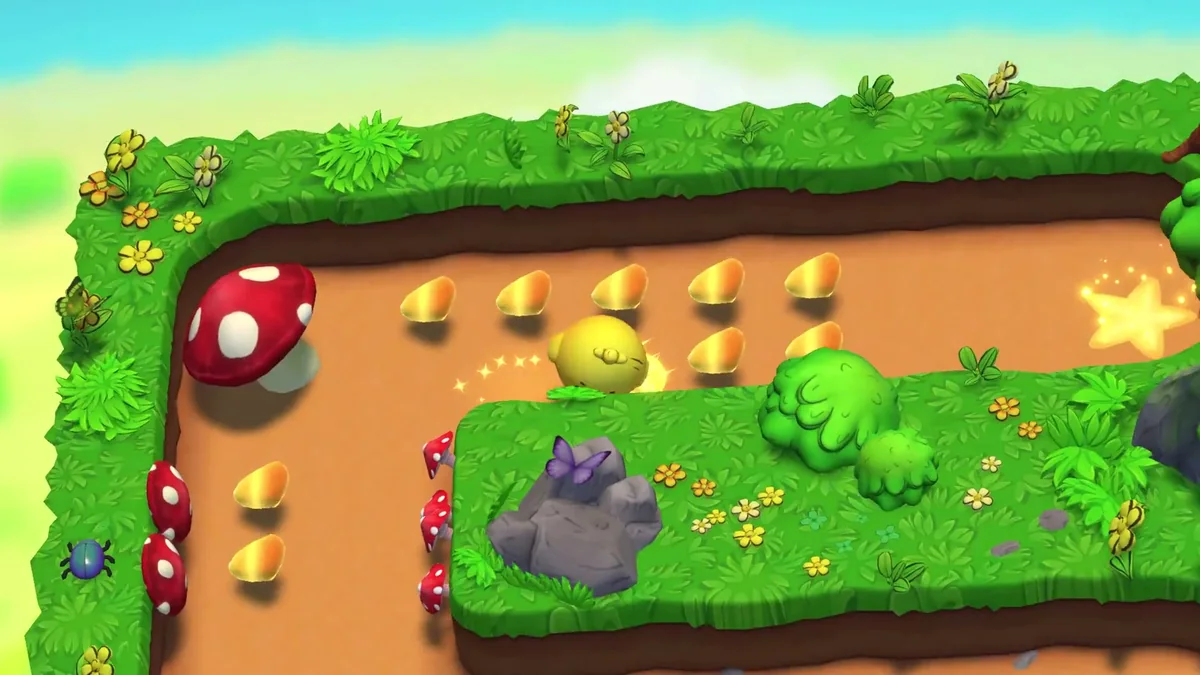
Enemies and momentum
The snow world introduces more moving hazards than the forest, including creatures that patrol narrow ledges. The same rule applies: they follow set paths and bump rather than chase. Do not try to fight them; there is no attack. Time your roll to pass behind them.
On ice, a bump is more dangerous than on grass because you cannot stop the resulting slide quickly. If a patrol is ahead, brake to a near-stop and wait. The level will not punish patience; it will punish a late correction.
Time Attack on ice
Time Attack turns the snow world into a routing exam. The target times assume you can hold a clean line, so the first step is to learn a route that does not require a mid-corner correction. A slower route with no brakes is often faster than a fast route with two saves.
Start with the shortest snow level and run it three times: once for corn, once for a clean line, once for speed. If you beat the target on the third run, you have found a route worth keeping. If you are still braking in the same corner, the corner is the problem, not your reaction time.
The Time Attack guide→ covers the badge system and the levels where the target time is more generous than it looks.
A clean-up order
Clear the world normally first. Then replay for corn, then for music tracks, then for Time Attack. Ice levels are easier to optimise once you have seen the whole route, and the corn routes often double as the fast routes because they follow the level's intended line.
For the no-death challenge, the snow world is a good place to build confidence but a bad place to take risks. The ice will carry a small mistake into a large one, so brake early and accept a slower clear.
Clear the level for corn before chasing its target time. The route knowledge carries over, and the extra corn often sits on the safer line.
FAQ
Why does the chick slide so much in Snowy Trail?
The world introduces ice, which reduces friction. The chick accelerates more easily and slows down more slowly, so braking must start earlier.
Is water an instant fail in Snowy Trail?
Water is a hazard, but the world also uses shallow channels and moving platforms. If a channel has no safe landing, treat it as a boundary; if it has stones or floes, cross at a diagonal.
Does Snowy Trail have a boss?
No snow-world boss has been confirmed. The world trophy is awarded for clearing its levels, and the story's final confrontation is in the Mystery Lair.
What are the star pickups for?
Stars appear as route markers and collectible pickups across several worlds. They are separate from corn; the 100% corn objective is tracked through the kernels, not the stars.
Official source: Marupoyo on Nintendo Switch 2 ↗
Related
- Marupoyo All Worlds Guide: Order and Hazards→
- Marupoyo Controls: Tilt, Brake and Momentum→
- Marupoyo Corn Guide: Every Kernel and Reward→