
Sand Sungold Guide: Marupoyo World 4 Block Routes
Marupoyo's desert world is built on movable blocks, switch plates and wide rolls. Learn the puzzle language before the camera pulls back.
Sand Sungold is the point where Marupoyo stops being a momentum game and becomes a momentum puzzle. The desert opens up, the camera pulls back, and the levels start using blocks the way other worlds use hills. A block can be a wall, a step, a bridge or a switch target depending on where it sits. The chick cannot jump over the problem, so the problem has to be rearranged. The all-worlds guide→ covers the world order and what each one introduces.
This guide explains the desert's block language, the wide-roll lines that survive the camera distance, and the collectible habits that keep a 100% run sane. It sticks to what the game shows and does not invent level names or boss phases.
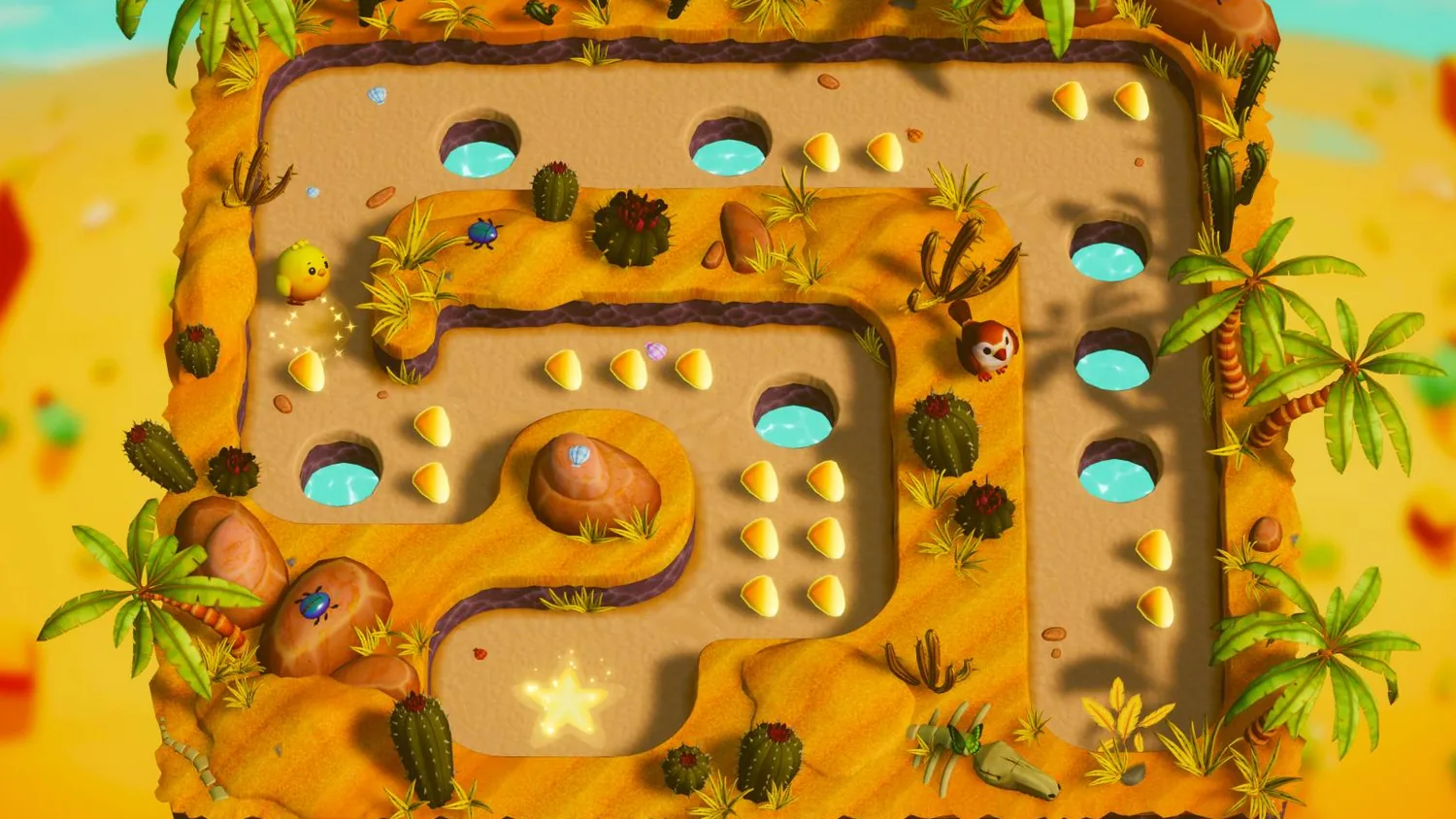
Blocks are geometry, not scenery
The first thing to unlearn from the forest is the idea that a block is an obstacle to roll around. In the desert, blocks are part of the floor plan. A low block is a step; a tall block is a wall; a block with a plate on top is a switch that changes something else in the room.
The camera gives you enough height to see the whole arrangement before you commit. Use that. Stop at the entrance to a room, look at the blocks, and trace the route you want before you touch the tilt. The desert rewards planning more than any other world.
If a route dead-ends, the answer is usually not a hidden ramp. It is a block you have not moved, or a plate you have not pressed. Roll a slow loop around the room and look for the piece that does not match the rest of the geometry.
Wide rolls and camera distance
The desert's plazas are wide enough that the chick becomes a small shape on screen. That extra distance is useful for planning but bad for reading speed. A roll that feels moderate up close can be a full-speed launch by the time the chick reaches the far side.
Use the brake to reset your sense of scale. A short tap at the start of a long straight tells you how much speed you are carrying. If the chick barely slows, you are already faster than you think.
The camera also hides the near edge of some platforms. When you approach a drop, aim for the far side of the gap rather than the near lip; the chick's momentum will carry her across, and the far side is easier to see.
Switch plates and sequencing
A switch plate is a target, not a button. The chick has no interact input, so the plate is activated by rolling over it or by putting a block on it. The level's sequence is usually: reach the plate, change the geometry, then use the new geometry to reach the exit.
The sequencing is where the desert gets its difficulty. A plate may open a bridge on the other side of the room, but the bridge may be timed. If you press the plate and then take a slow route, the bridge can close before you arrive. Learn the timing by pressing the plate once and watching, without trying to cross.
Once you know the window, the route becomes a straight line: plate, turn, bridge, exit. Do not add collectibles to that line until you can do it cleanly. The desert's corn is often placed to tempt you into a detour that costs the timing window.
Corn and the basket
Desert corn tends to sit on top of blocks and along the edges of wide plazas. The block-top kernels are the easiest to miss because the camera compresses height; a kernel that looks like it is on the ground may be one block up.
The footage also shows a basket-like object in the sand. Treat it as a landmark rather than a confirmed mechanic; the game has not published a basket-collecting system, and it may simply be scenery or a level-specific target. Do not build a route around it until you see it react.
For the last few kernels, check the back side of tall blocks. A block that is part of a puzzle often has a collectible tucked behind it, visible only from the exit direction. The corn guide→ explains how the 100% reward is tracked and why a level can show a full bar while still hiding a cluster.
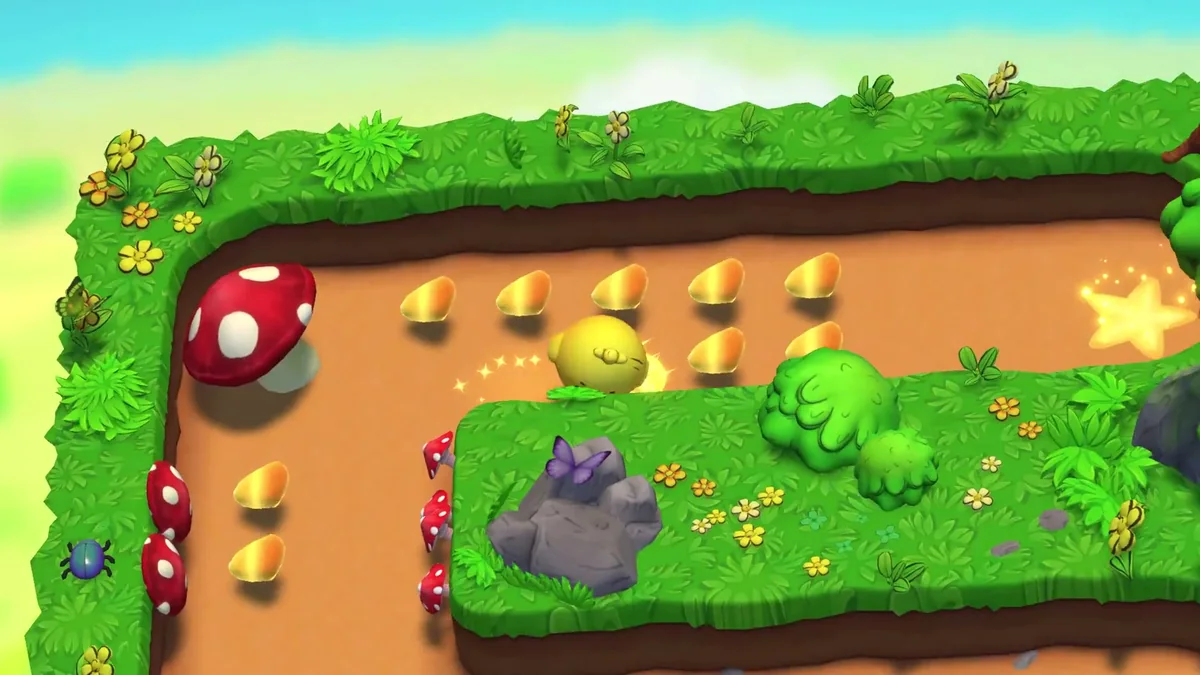
Enemies in the sand
The desert is less enemy-heavy than the volcano, but it is not empty. Small creatures patrol the wide plazas, and their paths are long enough that you can see them coming. The rule is the same as everywhere else: wait for the gap, then roll.
Because the plazas are open, you have more escape routes than in the lava world. If a patrol blocks the direct line, take the long way around the block and collect corn on the detour. The desert rarely punishes a patient route.
Time Attack in the desert
The desert is a good world for Time Attack because the routes are readable. The target times assume you understand the block sequence, so the first step is to learn a route that does not require a mid-room correction.
Pick the shortest block room and run it three times: once to learn the plate, once to learn the exit, once for speed. If you are still stopping to look at the blocks on the third run, the route is not ready. The Time Attack guide→ covers the badge system and the levels where the target is more forgiving than it appears.
Completion notes
Clear the world once without chasing 100%. Then replay for corn, then for music, then for Time Attack. The desert's block puzzles are easier to optimise when you already know which plates matter, and the corn routes often follow the same sequence.
For the no-death challenge, the desert is a confidence world: the hazards are readable and the enemies are slow. Do not get complacent on the wide plazas; a full-speed roll into a block wall can still cost a life.
Clear the level for corn before chasing its target time. The route knowledge carries over, and the extra corn often sits on the safer line.
FAQ
Can the chick jump in Sand Sungold?
No. The chick rolls and launches off ramps or bumps. The desert's blocks are solved by route and geometry, not by a jump button.
How do switch plates work?
A plate is activated by rolling over it or by placing a block on it. The plate changes something else in the room, often a bridge or a gate, and the change may be timed.
Does Sand Sungold have a boss?
No desert boss has been confirmed. The world trophy is awarded for clearing its levels; the story confrontation is in the final world.
Why does the camera feel so far away?
The desert uses wide plazas to show block arrangements. The distance is a planning aid, but it makes speed harder to judge, so brake early on long straights.
Official source: Marupoyo on Steam ↗
Related
- Marupoyo All Worlds Guide: Order and Hazards→
- Marupoyo Time Attack Guide: Beat Every Target→
- Marupoyo Corn Guide: Every Kernel and Reward→