
Marupoyo Review: A Small Game With a Sharp Hook
Marupoyo review: a $9 rolling platformer with 120 levels, two difficulty modes and a completion loop that is smarter than its price suggests.
Marupoyo is a game about a round chick who cannot jump. That one restriction is the whole design. Instead of pressing a button to leap, you tilt the world and let momentum carry you over gaps, around corners and down slopes. The brake is the only extra action. It sounds like a gimmick, and for the first few levels it is. Then the levels start asking you to plan a route the way you would plan a putt. The platform comparison→ explains which version gets which features.
At $8–10, with 120 short levels and two difficulty modes, it is a confident small game rather than a padded one. It is also not for everyone. If you want combat, a big story or a platformer where you can correct mid-air, this is the wrong pond.
What Marupoyo is
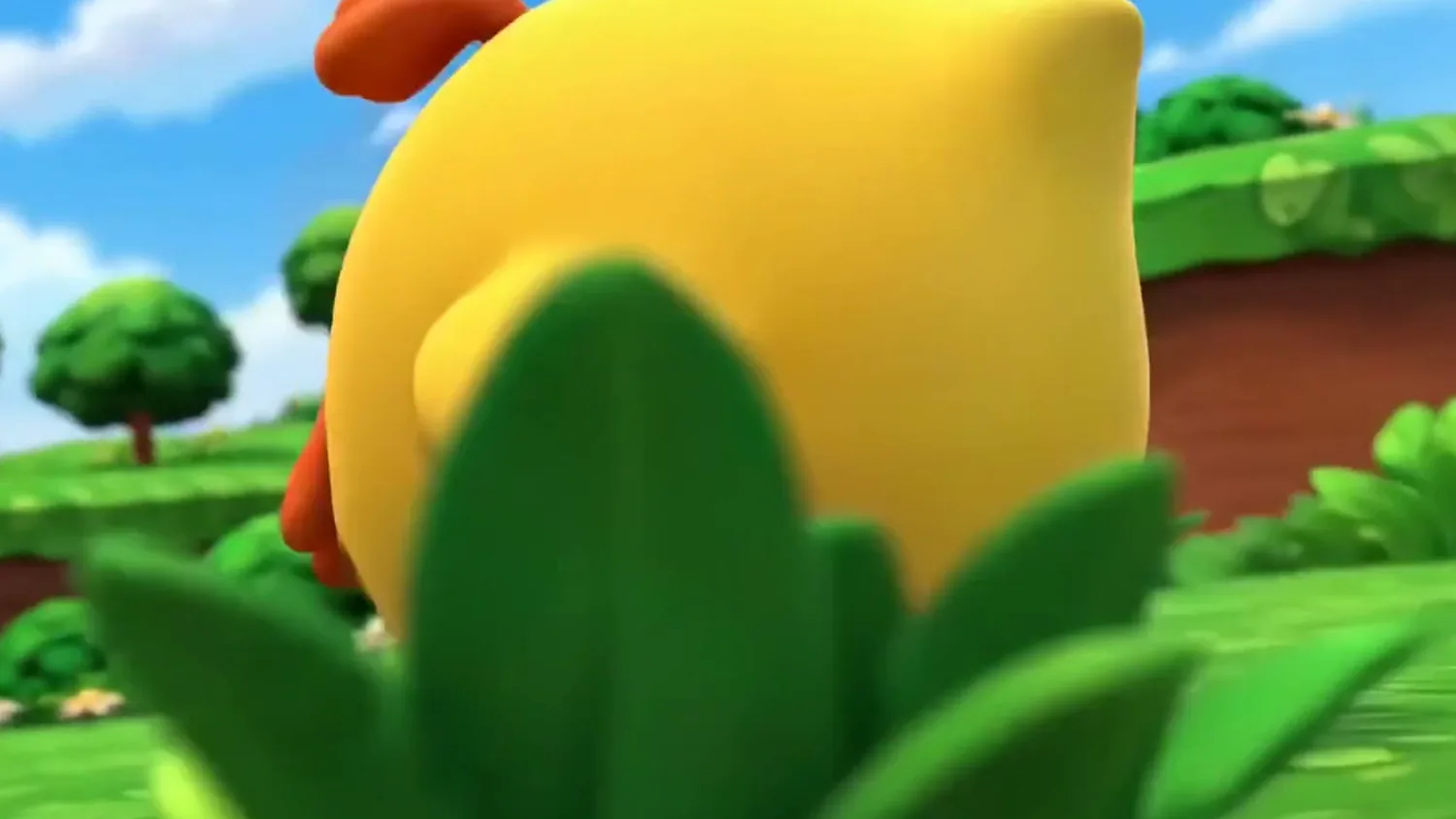
Marupoyo: The Round Chick's Adventure is a single-player tilt-based platformer from Casual Brothers. A tornado scatters the chick's family, and the Queen of Nature guides it across six worlds to rescue the siblings and stop an exiled Alchemist. The story is gentle, the stakes are small, and the ending is a lesson rather than a twist.
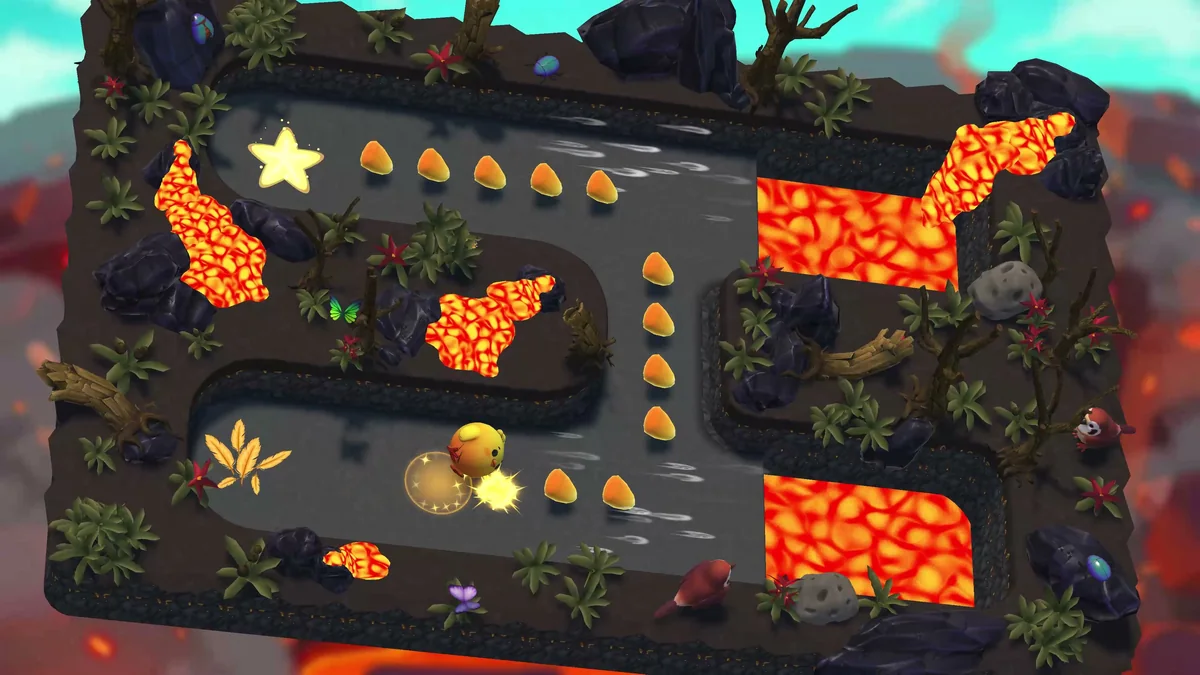
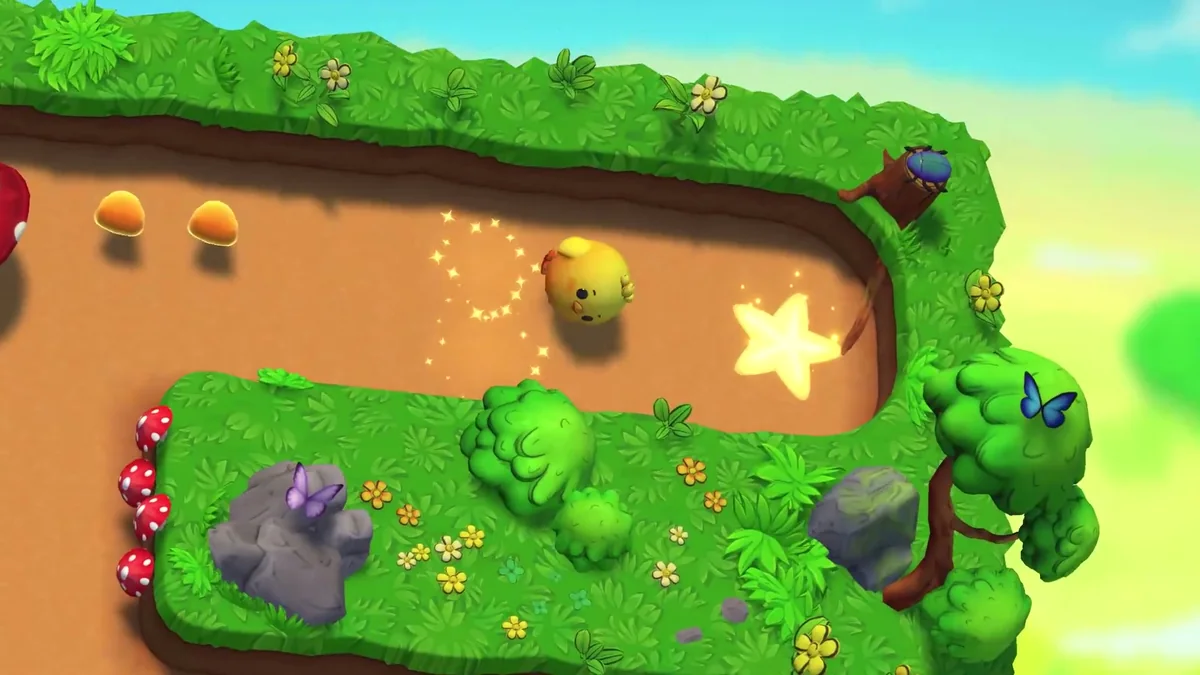
The game has 120 levels across Bumpy Forest, Snowy Trail, Streams of Joy, Sand Sungold, Red Volcano and Mystery Lair. Each world introduces a surface or hazard: mushrooms that launch you, ice that refuses to slow down, currents that add speed, blocks that reshape a route, lava that punishes a wide line, and a final lair that ties the systems together.
There is no jump button. The chick can roll and brake. Everything else, including the apparent jumps, comes from ramps, slopes and momentum. That is the sharp hook, and it is also the thing that will lose some players in the first ten minutes.
The two modes are the smartest part
Family Mode slows the game, covers hazards with cotton-like clouds and removes death entirely. Gamer Mode restores the speed, the hazards and the Time Attack layer. The two modes are not an easy/normal toggle; they are two different contracts with the player.
Family Mode is the reason a parent can hand the controller to a child without a lecture about lava. Gamer Mode is the reason the game has a completion loop for adults. The existence of both, on the same cartridge and download, is more thoughtful than the price suggests.
The cost is that neither mode is fully tuned for the other audience. Family Mode can feel too soft for an adult who wants to explore without challenge, and Gamer Mode can feel abrupt if you have only played the gentle version. The game expects you to pick a lane.
The rolling feels like planning, not reflex
The best levels are the ones where the route is visible before you move. A mushroom at the right angle, a slope that feeds into a current, a brake tap that sets up a corner: these are decisions, not reactions. When a level clicks, it feels like solving a small physical puzzle.
The weakest levels are the wide, flat ones where the only challenge is staying awake. The desert world has a few of these, and the early forest is gentler than it needs to be. The game's difficulty curve is back-loaded; the lair and the volcano are where the design earns its price.
The no-brake badge is the clearest expression of the idea. It asks you to read the geometry well enough that you never need to correct. That is a better challenge than a speedrun timer, and it is optional.
The completion loop is generous, with two sharp edges
Corn is the main collectible. Every level has a set, and 100% gives an extra reward and a medal. Siblings are the story collectible. Music tracks are hidden. Time Attack adds target times and badges. The PlayStation version wraps it in thirteen trophies; Steam has twelve achievements.
The loop is generous because most of it is per level and repeatable. You cannot permanently miss a level's corn by finishing the story. The two sharp edges are the campaign-wide no-death trophy and the no-brake objective. Both ask for a clean run over a long stretch, and both are best left until the routes are known.
The medal system is less clear than the corn counter. A level can be at 100% corn and still be missing a medal because the medal has a separate condition. The results screen is the authority, and the game could explain that better.
The presentation is small but consistent
The levels look like tabletop dioramas: soft grass, rounded trees, stepped sand, glowing lava. The chick is a simple round shape with a face, and the enemies are readable at a glance. The art does not try to be realistic, and it holds up in handheld mode.
The story is told in short scenes rather than long cutscenes. The Queen's guidance is functional, and the ending lands the theme of family without overexplaining it. Do not expect a Pixar script; expect a gentle fable.
Performance is the one thing I cannot judge from store data. None of the three platform pages publishes a frame-rate target beyond the Switch 2's 120Hz output support. The footage is clean, but footage is not a frame test.
Who should buy it
Buy it if you like physics puzzles, short sessions and completion loops. Buy it if you have a child and want a co-pilot game that does not punish them. Buy it if you want a cheap palette cleanser between larger games.
Skip it if you need combat, a skill tree or a jump button. Skip it if you only play platformers for precision movement; Marupoyo's precision is in the route, not the input. Skip it if a 120-level game with a simple story sounds like padding.
The verdict
Marupoyo is a 7.5/10 small game with a clear idea and a fair price. It is not the next great platformer, and it does not need to be. It knows what its one restriction can do, and it builds 120 levels around that restriction without repeating itself too often.
The Switch 2 version is the best fit for most players: cheapest, portable, motion controls. The PS5 version is for trophy hunters. Steam is for the demo and the language list. Whichever you pick, the game is the same, and the hook is the same.
The beginner guide→ explains the control model before you buy, and the world tier list→ ranks the six worlds by how well they use it.
Family Mode removes death and softens hazards, which hides the differences between worlds. The tier list assumes the standard, hazard-active mode.
FAQ
Is Marupoyo worth $9?
Yes, if you like physics-based platformers and short sessions. The campaign is 120 levels, and the completion layer adds Time Attack and medals.
How long is Marupoyo?
The store pages do not publish a playtime. The campaign is 120 short levels; completion adds a corn sweep, Time Attack targets and a no-death run.
Does Marupoyo have a jump button?
No. The chick rolls and brakes. Height comes from ramps, slopes and momentum.
Is Marupoyo good for kids?
Family Mode removes death and slows the game, which makes it suitable for young children. The standard mode is more demanding.
Official source: Marupoyo on Steam ↗
Related
- Marupoyo Beginner Guide: Roll Before You Run→
- Marupoyo Platforms: Switch 2 vs PS5 vs Steam→
- Marupoyo Time Attack Guide: Beat Every Target→